Close Enough Was Kind of the Point
This is another baseball post. Sort of.
I like ABS.
The rest of this piece might sound like I don’t. Or maybe it sounds like I’m ready for our robot overlords. It’s a little hard to tell day-to-day, to be honest.
I think the Automated Ball-Strike system is one of the cleaner, more defensible changes MLB has made in a generation of rule changes that have been, uh… mixed. (I can’t abide the structual aesthetics of the DH. I believe we should have ties before zombie runners.)
But the strike zone is defined in the rulebook. It has always been defined in the rulebook. A pitch that crosses the zone is a strike; one that doesn’t, isn’t. That’s not technically a judgment call—it’s binary: it is or it isn’t. And for most of baseball history, we handed that binary choice to a human being standing two feet away, who had an interpretation of the zone that varied every night; shaped by the count, the pitcher’s reputation, the subtle, sneaky skills of the catcher, and the measure of just how long the umpire wanted to stand behind home plate. (We all get tired… give the man a break, he just wants to go home.)
Without question, ABS provides a partial solution to a problem that has always, technically, been an issue. Generally speaking—as a pragmatist (the ideologues are already on their way to the comments), I’m for it.
And like most compromises I can get behind, I’ve spent more time thinking about what it means than one would think healthy.
A quick word on bona fides.
I have written about one of my earliest memories—a baseball memory. And about what Ryne Sandberg meant to me growing up in a Cubs household. In short: baseball means something more than “sport” or “pastime” to me. It’s closer to a civic religion. As a skeptic and agnostic, it’s the closest I’m getting to mysticism. It’s ritual.
I say this so you know I’m not talking about ABS relative to automation and tech as an aloof, thought-leadershipy, LinkedIn dork. I have genuine feelings about this sport.
I’m a whole different kind of dork.
Fact is, the umpire’s inconsistent strike zone wasn’t supposed to be part of the game. It was never a feature. Nobody wrote it into the rulebook. It was just the inevitable human element that came with having a human being make the call. A call that happens hundreds of times per game. Over more than 150 years. Lacking a better solution, what are you going to do?
And one can’t look at zone inconsistency without acknowledging the skill behind it. Pitch framing! How can you explain peak José Molina? Or a veteran pitcher who knows how to work this ump’s zone. Or the mind games—the manager who knows when to thrown a tantrum and get in an ump’s head. None of that was supposed to exist. But it exists nonetheless because humans were making the calls and other humans adapted to the fact that those first humans make errors and can also be manipulated into making errors for the benefit of one team over the other.
So what happens to that craft now? While the challege system means many of these aspects remain—though diminished—in the game, you have to wonder how long it will be before ABS is calling all the pitches, and we’ve slid to the bottom of the slippery slope.
This week, I finished listening to a recent two-part series from the podcast Search Engine, which covered autonomous vehicles. The primary business argument for driverless cars is, at its core, the same argument as ABS: humans make errors, the errors are measurable and preventable, the technology is more accurate than most humans.
That’s an argument that’s hard to dispute. The numbers aren’t lying. Humans don’t have the best track record in this department.
Then there’s accessibility. Disability rights advocates make a very compelling case. Autonomous vehicles mean individual autonomy for people who otherwise cannot get around. Moreover, when you request a ride, they won’t refuse a fare based on your disability. For as much hidden bias exists in our technology, driverless cars won’t discriminate against you.
And then, also, I also cringe when I see a Waymo. Ew. Tech-billionaire hubris made manifest. Outside the folks who have the greatest claim to supporting driverless cars (“I can’t get around and Uber’s are unreliable”), everyone else championing them seem to be a mix of investors in the tech itself and be-vested tech bros who see working during their commute as a great time to leverage their precious time optimizing their tech stacks (and avoiding their families).
So yeah, I contradict myself.
Regardless, the podcast really made me think through the complexity of (a) making things right for right’s sake (in the case of disbility advocates, encouraging a more just society), and (b) ripping a band-aid off and throwing working people under the very autonomous cars that will replace them (in the case of the newly organized working drivers).
And those are the more obvious complications. What about the second- and third-order effects of removing human judgment from something so embedded in daily life? What will we miss that we don’t even know is there?
In 1998, Kerry Wood struck out a record 20 batters during his fifth career start.
The game was already well under way when I got home from school. I turned on WGN like I normally would and there was already a buzz coming from the broadcast. It was exciting. With each ensuing stikeout, I’d do the math…could he get the record? Were there enough outs left? I was 11 and unconcered with the details: Kerry’s stuff was electric. The crowd was going nuts.
Fast-forward twenty-five years. I decide to re-watch the game. Kerry’s stuff WAS eletric. Twenty-five years past, 800 miles away, more than 65,000 major league games transpiring since, and all the while knowing the outcome—the tension was palpable.
But with experienced, more-discriminating eyes, I saw more of the story. Home plate umpire Jerry Meals had a very generous zone that day. And each time he called a that low-and-away pitch a strike early in the game…
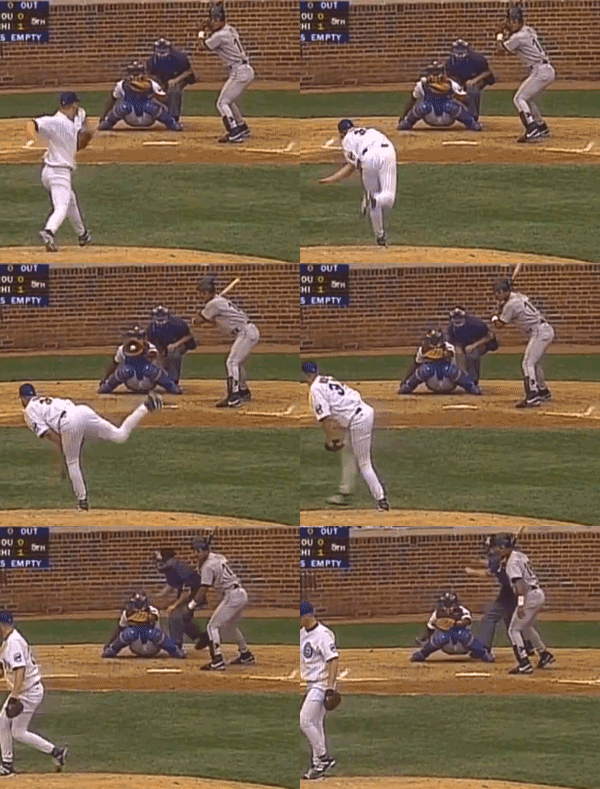
…the more likely Derek Bell or Brad Ausmus or Ricky Gutíerrez was going to take whiff at it later in the game, trying hopelessly to protect the plate.
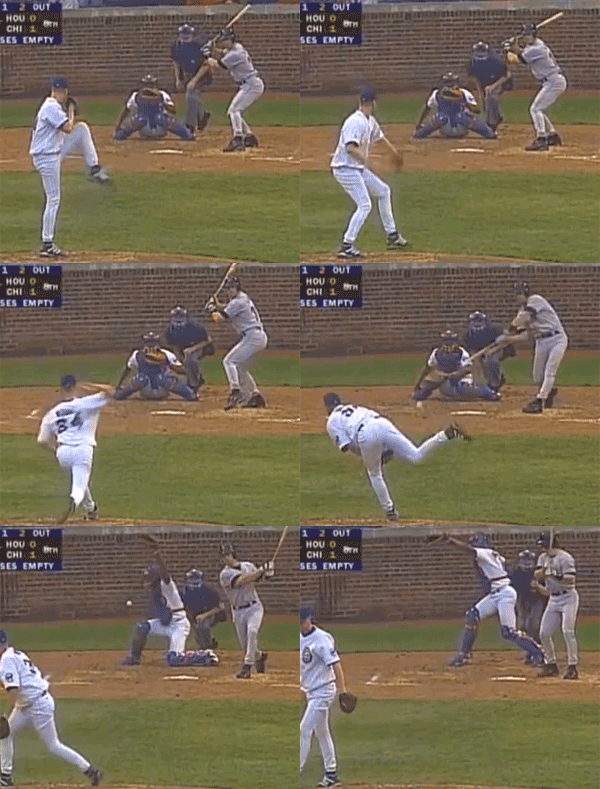
I’m not taking anything away from Kerry’s performance that day—it was incredible. And the swings-and-misses prove it. But it also happened within the context of a game that included a malleable strike zone, called by a human umpire, for the benefit and detriment of both teams.
It was part of the game. And it remains part of the story.
I think, as a culture, we can be comfortable with certain things being a little wrong for the sake of efficiency, human ease, and a little bit of drama. The ump misses a call. Everybody argues about it. Somebody brings it up on the way home. “Close enough” isn’t just tolerance for error—sometimes it’s the thing that generates the story.
When we demand exactness everywhere, we tend to lose more than the errors. We lose the conversations that formed around them. And there’s something else that happens when movements—political, cultural, whatever—decide that exactness is the only acceptable standard, and partial agreement or compromise or pragmatism is indistinguishable from opposition. The argument is the point. It’s the rock-tumbler that turns our ideas into gems.
I’m not saying this to argue for blown calls. Nor am I saying we shouldn’t hold ourselves to high moral standards in our political activities. I’m saying the social function of “close enough” is real and underappreciated, and we should at least notice when we’re optimizing it away. We should consider what we might stop learning about each other when we stop having the argument.
This isn’t an abstract question for me. It’s just a regular work day.
AI now drafts copy. Automated pipelines publish and validate content. The efficiency argument is as clean as the ABS argument. The tools are pretty good. The output is often more than acceptable.
They’re tools to wield to get a job done.
But real craftwork exists only because humans were doing the work. That’s true for any person. For me, it might be the judgment call that decided what didn’t get included in a doc, the instinct about what a user actually needs versus what they asked for. What happens when I start ceding those decisions to the AI? What skill quietly disappears when I stop needing it. Craftsmanship is a practice. If you don’t work at it, you atrophy.
I like the ABS challenge system because the strike zone was always supposed to be consistent, and now there’s an out when the call is egregious. But I’m wary of that logic extending to everything, because most things can’t be measured the same way. Most things don’t have a rulebook definition of correct. Most things require judgment, and judgment is exactly what we tend to treat as inefficiency when we’re optimizing.
Are we being intentional about what we hand to automation and what we hold onto for ouselves? It doesn’t seem like it. The tech world seems dead-set on plunging forward, callously displacing people with the same lack of empathy as the AI they are foisting on us from every direction.
But I think (and hope) that we will see blowback. Yes, out of nostalgia and naïve romanticism over imperfection, but also because some things derive meaning from the fact that a human being, with all the limitations and frailties and eccentricities and ego and selflessness and cruelty and kindness and on and on, is the one doing them.
And we get to choose what those things are. We can create. We can express. We can touch grass.
We just have to choose to do it ourselves. We have to call ‘em like we see ‘em.
Search Engine is so good
Their series on autonomous vehicles is—like all of their episodes—great craft. Totally in my podcast pantheon. Go check them out.
Learn more