The Ops Role Your Growing Company Hasn't Hired For

Marketing Ops. Enablement Ops. Growth Ops. Revenue Ops. Support Ops. I’m waiting for someone to suggest Operations Ops with a straight face.
But if you’ve been reading this blog, you’ll know Content Engineering is that same idea, applied to documentation. One person, with the right process and the right automation, can run the knowledge management for a company moving faster than its headcount should reasonably allow. It just doesn’t usually get hired for until the chaos has already set in.
Hiring technical communicators early in a company’s growth period has always been a good (if underused) move. The job is making sure customers and employees both have accurate, current information about a product that’s changing constantly—external docs, internal docs, the whole apparatus. Early-stage companies that skip it aren’t saving money so much as deferring a bill.
The internal side is what usually gets ignored first. Nobody schedules time for internal knowledge management when the org chart is a handful of people and everyone just knows things. But the external side is getting harder to kick down the road too—and for a newer reason: AI tools are reading your documentation now, not just your customers. Thin or stale product content doesn’t just shortchange a user in your content ecosystem anymore, it teaches a model an incomplete or outdated answer. And the model repeats that answer—and whatever information it decides to hallucinate to fill the gaps—with total confidence to everyone who asks it something.
Put a technical writer at the center of Product, Engineering, Marketing, and Customer Success early, and you’re not just producing docs. You’re building the thing your field team and your AI tools both go to when they need to be sure they’re right. And if that person also knows how to build the systems around their own output—automation, structure, workflow, the Content Engineering—you get a lot more than one hire’s worth of coverage. Fewer hallucinated answers. Fewer field reps guessing. Fewer of the internal breakdowns that end in a Slack thread titled, more or less, “what are we even doing here.”
Whatever you call it—Content Engineering, content ops, technical writing with extra steps—it’s a grounding function. Bring it in early, and you’re buying stability you’d otherwise have to build under pressure later.
So where do you actually start with making Content Engineering your next ops role?
The Content Engineering Starter Pack
Where They Sit
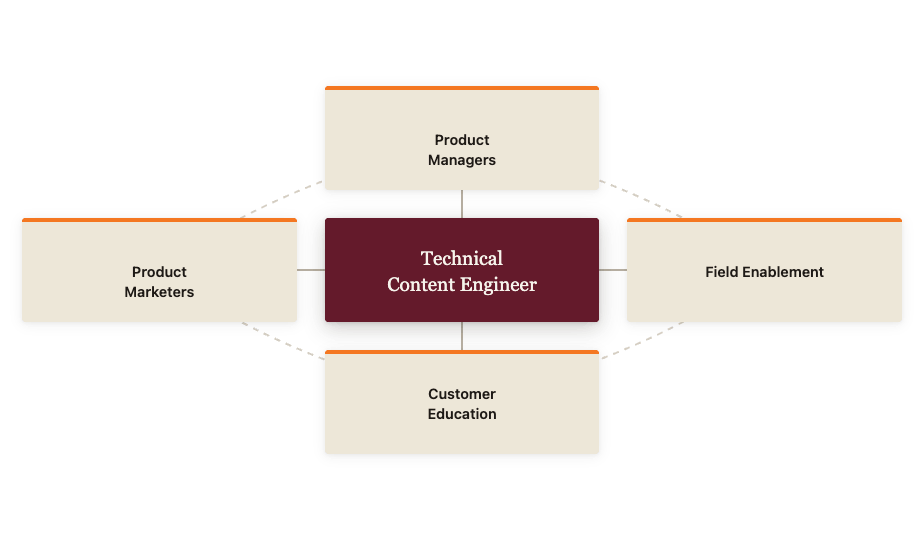
Content engineers can report into Product, Marketing, or Customer Success—the org chart placement matters less than people might think. What actually matters is where they sit relationally, at the intersection of the teams running go-to-market. Product managers, product marketers, field enablement, customer education: that’s where the content engineer needs a place, regardless of which department signs their offer letter.
Pass the Word
The easiest failure to miss, and the most damaging one, is broken knowledge transfer between Product and whoever’s executing GTM. If your field team can’t plan around a feature because nobody told them it shipped yesterday, that’s not a communication hiccup. That’s a process gap with a customer-facing consequence.
Consistent internal docs. Regular check-ins with the full GTM team. Actually paying attention to the Slack channel instead of trusting it to osmose into people’s brains. None of that is glamorous, but it’s the table stakes that make everything downstream—every automation and external-facing update trustworthy instead of lucky.
Touch Grass
Knowledge transfer doesn’t stop at Product-to-GTM. Customer Success and Marketing need to be talking to the content engineer too.
Technical writers are often a few steps removed from the people actually using the product. That’s structural, not a personal failing—but it means someone has to build the bridge on purpose. They need a reality check from time to time. Give your content engineer real exposure to customer feedback, real visibility into how the product solves problems in the field, and a real way to see the gap between how R&D designed a feature to be used and how customers are actually using it. That gap is usually where the best and most necessary content ideas live.
The Stack
Most modern startups probably already have all the pieces of a Content Engineering tech stack. Much of that is driven by the stacks other departments use anyway. The main way a content engineer can operationalize content is through integrating and leveraging automation and AI tooling across other existing platforms.
Today, this might include:
- Content automations driven by Atlassian workflows in Jira and fine-tuned with their Rovo AI.
- Scheduled tasks built on Claude Cowork projects to draft and review docs.
- Any number of n8n or Zapier workflows triggered by webhooks.
- Custom Slack apps connecting teams to content.
The main tools specific to Content Engineering and its operationalization are:
- A git-friendly Doc-as-Code platform (or—at the very least—a CMS with robust API or MCP functionality).
- Enterprise developer access to an AI dev platform like Claude Code or Cursor.
I do this work every day, and I’m still stunned by how much I can do with the tools in front of me.
Measure for Measure
Measurement has always been the tricky part. Standard content metrics don’t map cleanly onto technical content. A high time-on-page number might mean your content is genuinely useful and worth sitting with—or it might mean nobody can figure out what you’re telling them as they read and re-read your article. Historically, the best proxy has been indirect: comparing sessions against support ticket volume and inferring deflection from the gap.
Two things have made this less murky:
- AI support bots trained on your content give you something closer to a direct read: if the bot answers a question completely, with no human follow-up needed, that’s a deflected ticket you can actually point to and claim.
- Tracking how your content performs in AI search—whether it’s getting found, ingested, surfaced, and cited—tells you something that used to be invisible: how well your knowledge base is doing its job for the people, and increasingly the agents, asking it questions on your behalf.
This is Content Engineering—the new Ops role. None of it requires a content team. It requires one person, positioned correctly, with the mandate to build process and connectivity instead of just producing pages.
Early-stage companies hire for Growth Ops and Revenue Ops without blinking.
The knowledge that holds the rest of it together is worth the same bet.